
The best AI SEO content writer is the one that fits your workflow, from hands-on assistance to full automation. For teams wanting SERP-driven guidance to optimize drafts, Surfer SEO is a top choice. For businesses seeking to put their entire blog on autopilot, PilotScribe offers a complete, autonomous solution.
This guide ranks the top tools across this spectrum, helping you find the right balance of control and efficiency for generating content that actually ranks on Google in 2026.
How We Evaluated the Top AI SEO Writers
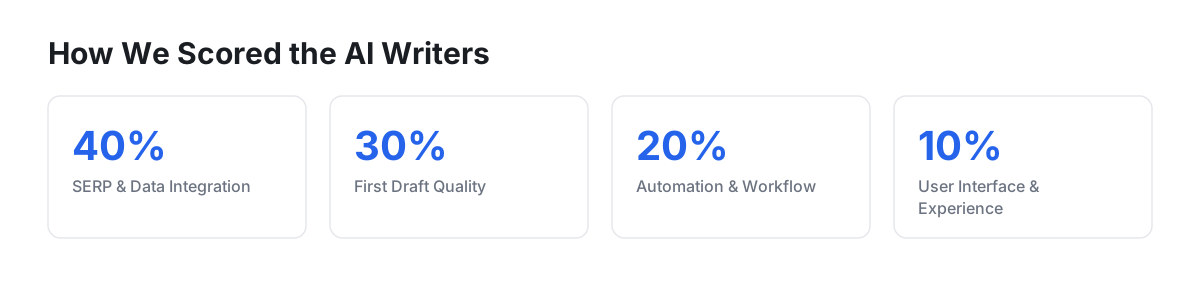
Choosing the right tool goes beyond just generating text. A top-tier AI SEO writer must integrate with a real content workflow. To move beyond generic claims, we established a clear evaluation framework based on a real-world task: creating a 2,000-word article for the keyword "B2B content marketing strategy."
We judged each platform on four key criteria:
- SERP & Data Integration (40%): How well did the tool analyze the live SERP? We scored its ability to identify key topics, entities, competitor structures, and user intent questions, giving higher marks for tools that provided a data-rich brief.
- First Draft Quality (30%): Using the tool's primary AI writing feature, we generated a first draft. This was scored on factual accuracy (checked against known sources), narrative flow, readability, and uniqueness (to avoid formulaic AI patterns).
- Automation & Workflow (20%): We assessed the tool's ability to streamline the entire process. This included everything from initial topic discovery to CMS integrations (WordPress, Webflow, etc.) and post-publication features like performance tracking.
- User Interface & Experience (10%): We evaluated how intuitive the platform was. A clean, logical interface scored higher than a cluttered or confusing one with a steep learning curve.
AI SEO Content Writer Comparison
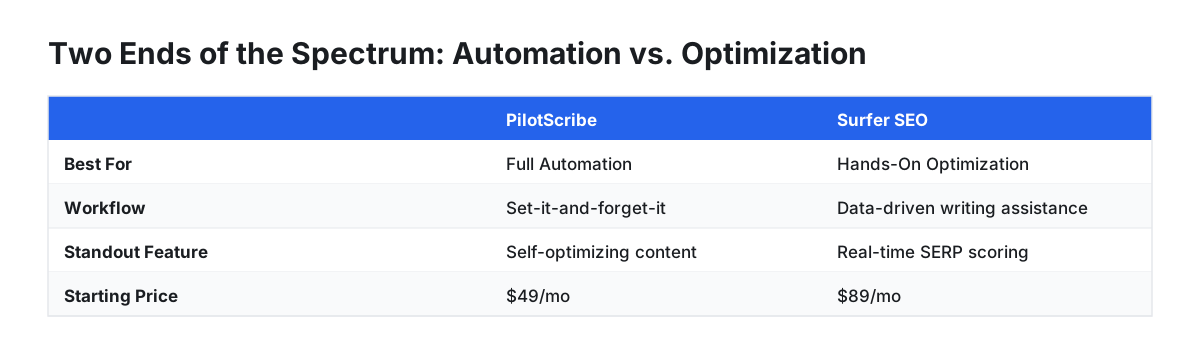
Here’s a quick overview of the top AI SEO writers and who they’re best for. Deeper reviews for each tool follow below.
| Tool | Best For | Standout Feature | Starting Price |
|---|---|---|---|
| PilotScribe | Fully autonomous blog growth | Automatically improves underperforming content post-publication | $49/mo |
| Surfer SEO | Hands-on content optimization | Real-time content editor with SERP-based scoring | $89/mo (Essential plan) |
| Clearscope | Enterprise-grade content briefs | High-relevance topic modeling & grading | $199/mo (Standard plan) |
| Jasper | Versatile marketing copy creation | Brand voice and massive template library | $49/mo (Creator plan) |
| Agility Writer | Factual, in-depth long-form articles | Advanced SERP analysis and factual data integration | $25/mo |
| MarketMuse | Enterprise content strategy | AI-driven topic modeling and content inventory analysis | Free plan; paid plans start at $149/mo |
| Scalenut | Guided, semi-automated article drafting | "Cruise Mode" for building briefs and first drafts | $39/mo (Essential plan) |
| Writesonic | All-in-one content creation | AI Article Writer 5.0 for high-quality drafts | $20/mo (Pro plan) |
| Frase | Research and content brief creation | Fast SERP analysis and brief generation | $14.99/mo (Solo plan) |
| Rytr | Budget-friendly short-form content | Generous free plan and simple UI | Free plan; paid plans start at $9/mo |
| GrowthBar | SEOs wanting an all-in-one tool | Integrated keyword discovery and content outlines | $48/mo (Standard plan) |
| ChatGPT / Gemini | Brainstorming and initial drafting | General-purpose flexibility and accessibility | Free; paid tiers (Plus/Advanced) available |
Feeling overwhelmed by the manual work of managing briefs, drafts, and optimizations? A fully autonomous platform can run your entire SEO content strategy for you. PilotScribe analyzes your site, finds topics, writes, publishes, and even improves your content automatically.
The 12 Best AI SEO Content Tools Reviewed
Here's a detailed breakdown of each tool, its strengths, weaknesses, and ideal user.
1. PilotScribe
Best for: Fully autonomous blog growth for founders, agencies, and SaaS.
PilotScribe represents the full-automation end of the spectrum. It's designed to be a set-it-and-forget-it system that handles the entire SEO content workflow. You connect your site, and it autonomously identifies high-opportunity topics, writes long-form articles, and publishes them to your CMS. Its most unique feature is its post-publication optimization; the system monitors Google rankings and automatically rewrites and improves articles that fail to perform, creating a self-healing content strategy.
Pros:
- Truly end-to-end automation saves significant time.
- Self-optimizing content is a powerful long-term advantage.
- Excellent for scaling content across multiple sites (agency-friendly).
Cons:
- Requires trusting the AI with strategic decisions like topic selection; less ideal for control-oriented marketers.
- Maintaining a consistent, nuanced brand voice across dozens of automated articles requires careful initial setup and periodic review.
- The hands-off approach may not be suitable for highly technical or niche industries requiring deep subject-matter expertise for every post.
2. Surfer SEO
Best for: Hands-on content teams and SEOs focused on optimizing every article against SERP data.
Surfer SEO is the market leader for data-driven content optimization. Its Content Editor provides a real-time, gamified experience for writers, scoring their draft against 500+ on-page signals derived from top competitors. It excels at turning the abstract goal of "ranking higher" into a concrete checklist of terms to include, structural elements to add, and readability targets to hit. While it now has an AI writer, its core value remains its powerful brief and optimization engine.
Pros:
- Provides best-in-class, actionable guidance for on-page SEO.
- Excellent for training writers and enforcing content standards.
- Grow Flow feature suggests low-hanging-fruit optimizations for existing content.
Cons:
- Chasing a 100/100 score can lead to keyword-stuffing and unnatural writing if not balanced with human judgment.
- The interface can be overwhelming for beginners, and the cost is high if you only need a simple AI writer.
3. Clearscope
Best for: Enterprise teams and agencies needing high-relevance, shareable content briefs.
Clearscope is a premium competitor to Surfer, focusing heavily on semantic relevance and topic modeling. It produces highly detailed reports that grade your content on the inclusion of important terms and topics. Its briefs are considered by many to be the industry standard for clarity and depth, making it easy for content managers to delegate writing to internal or external teams with confidence. It is less a writer and more a content intelligence platform for ensuring topical authority.
Pros:
- Excellent for creating authoritative, comprehensive content.
- Reports are easy for non-SEO writers to understand and use.
- Integrates with Google Docs and WordPress for a seamless workflow.
Cons:
- High starting price makes it inaccessible for many small businesses and solo creators.
- Does not have a built-in AI writer; it's purely an analysis and optimization tool.
4. Jasper
Best for: Marketing teams needing a versatile AI writer for various content types, from ads to blogs.
Jasper excels at producing creative and brand-aligned copy across a huge range of formats. Its Brand Voice feature allows it to learn your style, and its massive template library speeds up the creation of everything from social media posts to email campaigns. While it can write long-form blog posts, its primary strength is its versatility as a general marketing assistant.
Pros:
- Produces high-quality, creative copy that often requires minimal editing.
- Brand Voice and template features are top-notch for marketing teams.
- Strong collaboration features and a polished user interface.
Cons:
- The built-in SEO features lack the depth of dedicated tools like Surfer or Clearscope.
- Long-form content can sometimes meander or lose focus without a very strong outline and careful guidance.
5. Agility Writer
Best for: Creating factual, in-depth long-form articles with a focus on accuracy.
Agility Writer is a specialized tool for producing high-quality, long-form articles, particularly product roundups and detailed guides. It performs an advanced SERP analysis to pull in factual data and structure articles logically. Its output is often more accurate and requires less fact-checking than general-purpose writers, making it a favorite for affiliate marketers and publishers who value authority.
Pros:
- Excellent at creating factually dense, well-researched articles.
- 'Advanced Mode' gives granular control over outlines and sources.
- Strong performance on complex topics and affiliate-style content.
Cons:
- The user interface is more functional than polished compared to competitors.
- Lacks the broader marketing and collaboration tools of platforms like Jasper.
6. MarketMuse
Best for: Enterprise content strategy and building topical authority at scale.
MarketMuse is a powerful content intelligence platform that goes beyond single articles. It analyzes your entire website to identify content gaps, build topic clusters, and prioritize what to write next to achieve topical authority. Its suite of tools helps strategists plan and optimize content on a portfolio level. While it has AI writing features, its core value is in high-level strategic planning.
Pros:
- Unmatched for content inventory, auditing, and strategic planning.
- Excellent at visualizing topical authority and finding content gaps.
- Offers a limited but useful free plan for getting started.
Cons:
- Extremely complex with a steep learning curve; overkill for smaller sites.
- The paid plans are very expensive and geared toward large enterprises.
7. Scalenut
Best for: A guided, semi-automated process for creating SEO articles from scratch.
Scalenut's "Cruise Mode" is a standout feature that creates a streamlined, step-by-step workflow for drafting an article. It guides you from keyword to outline, SERP analysis, and first draft generation. This makes it an excellent choice for users who want more guidance than a blank page but more control than a fully automated system. It strikes a good balance between AI assistance and user oversight.
Pros:
- User-friendly workflow simplifies the SEO writing process.
- All-in-one platform includes topic clustering and optimization features.
- Offers a free plan for low-volume users.
Cons:
- The AI-generated prose can sometimes feel formulaic and require significant editing for a unique voice.
- The sheer number of features can make the interface feel cluttered.
8. Writesonic
Best for: An all-in-one content platform for generating high-quality drafts quickly.
Writesonic is a powerful and versatile AI writer with a strong focus on generating factual, ready-to-use long-form content. Its AI Article Writer 5.0 is capable of producing well-researched articles that often require less editing than many competitors. It also includes Photosonic for AI image generation and Chatsonic, a ChatGPT-like assistant with access to live Google data.
Pros:
- Generates high-quality, factual long-form drafts efficiently.
- Comprehensive toolkit includes AI chat, image generation, and landing page tools.
- The free trial is generous, allowing for a thorough evaluation.
Cons:
- The quality can be inconsistent across its many different tools and templates.
- The credit-based system on some plans can be confusing to manage.
9. Frase
Best for: Content strategists and writers focused on rapid research and brief creation.
Frase excels at the research phase. It rapidly analyzes top search results and generates a comprehensive content brief, including competitor outlines, user questions from People Also Ask and Reddit, and key topics to cover. It's a massive time-saver for anyone who builds content outlines. While it has an AI writer, its core strength is as a research accelerator.
Pros:
- Generates incredibly detailed and actionable content briefs in minutes.
- Excellent for understanding user intent and ensuring comprehensive coverage.
- Affordably priced for its research capabilities.
Cons:
- The AI-generated text is often basic and requires significant rewriting to be publishable.
- More of a writer's assistant than a replacement for a writer.
10. Rytr
Best for: Budget-friendly short-form content and users needing a strong free plan.
Rytr is known for its simplicity and affordability. It offers a clean interface and a wide range of use cases, from blog sections to social media updates. Its most compelling feature is its generous free plan, which provides enough credits for users to generate thousands of words per month. It's an excellent entry point into AI writing for those on a tight budget.
Pros:
- One of the best free plans available on the market.
- Simple, intuitive interface is perfect for beginners.
- Very affordably priced paid plans.
Cons:
- Long-form content generation is weaker than specialized tools; best for short snippets.
- Lacks any built-in SERP analysis or SEO optimization features.
11. GrowthBar
Best for: SEOs and marketers who want topic discovery and content writing in one tool.
GrowthBar integrates the SEO workflow from start to finish. You can perform keyword research, analyze competitors, and then generate a content outline and draft all within one platform. Its one-click outline generation is a major time-saver, pulling in keywords, headlines, and links from ranking competitors. The handy Chrome extension also brings these features to any page you're browsing.
Pros:
- Streamlined workflow from initial search to finished draft.
- The Chrome extension is highly convenient for on-the-fly analysis.
- Good value for an all-in-one SEO and writing tool.
Cons:
- Its SERP analysis is not as deep or detailed as that of Surfer or Clearscope.
- The quality of the AI-generated prose can be less polished than premium writers like Jasper.
12. ChatGPT & Gemini
Best for: Brainstorming, outlining, and creating initial, unoptimized drafts.
General-purpose models like ChatGPT and Gemini are powerful creative partners. They are unmatched for brainstorming ideas, structuring arguments, rewriting awkward sentences, and generating raw text to get you started. Their flexibility is their greatest strength.
Pros:
- Extremely versatile for any text-based task.
- Powerful free versions are accessible to everyone.
Cons:
- They have no connection to live SERP data and cannot perform SEO analysis.
- Their output is a blank slate that requires a separate tool (like Surfer or Clearscope) and significant human editing to become a competitive SEO article.
Are There Any Good Free AI SEO Content Writers?
Yes, several tools offer meaningful free plans, but they come with limitations. They are best used for short-form content, testing a platform's capabilities, or supplementing a low-volume workflow. A free tool will not replace a paid, specialized SEO writer for a serious content strategy.
Here’s how the top free plans compare:
| Tool | Free Plan Offering | Key Limitation |
|---|---|---|
| Rytr | 10,000 characters (~2,500 words) per month | No SEO features, limited long-form capabilities |
| Writesonic | 10,000 words per month (using premium quality) | Limited to one user, fewer advanced features |
| Scalenut | 2,000 AI words and 2 SEO reports for life | Very limited usage, not sustainable for regular publishing |
| MarketMuse | 10 queries per month | Limited to high-level analysis, not content generation |
| ChatGPT/Gemini | Unlimited conversations | No real-time SERP data or specific SEO guidance |
FAQ
What is the best AI for SEO content?
The best AI for SEO content depends on your workflow. For a fully automated, hands-off approach, PilotScribe is the best choice because it manages the entire process and optimizes content post-publication. For hands-on teams who want data-driven guidance while writing, Surfer SEO is the top pick.
Is SEO still worth it in 2026?
Yes, SEO is more important than ever in 2026. As AI generates more content, the value of ranking at the top of Google for strategic keywords increases. High-quality, authoritative content that directly answers user intent will continue to drive valuable organic traffic, which remains one of the most cost-effective marketing channels.
What is AI SEO called now?
AI SEO is often referred to as "AI-driven content optimization" or "Generative SEO." The term reflects the shift from using AI simply for finding search terms to using generative models to create, optimize, and even automate the entire content lifecycle to align with search engine algorithms and user intent.