
The HubSpot AI Blog Writer is a suite of artificial intelligence tools integrated into HubSpot's Content Hub and free CMS. It helps users generate blog ideas, create outlines, draft entire posts, and refine copy. It functions as a co-pilot, designed to accelerate the manual content creation process.
HubSpot has integrated AI across its platform, turning its blogging software into a powerful content assistant. For marketers already invested in the HubSpot ecosystem, these tools can streamline workflows. But how do they work, what are their limitations, and are they the right fit for scaling your SEO? This guide breaks down everything you need to know.
What Is the HubSpot AI Blog Writer?
The HubSpot AI Blog Writer isn't a single, standalone product but a collection of AI-powered features built directly into the HubSpot platform. Its primary function is to assist human writers by automating specific parts of the content creation process. Think of it as an assistant that can handle brainstorming, outlining, and drafting, which a human writer then refines, fact-checks, and optimizes.
These tools leverage large language models to understand prompts and generate human-like text. They are accessible within the blog editor of HubSpot's CMS and other content creation areas, allowing users to generate copy without leaving the platform.
How to Generate a Blog Article with HubSpot's AI
 Generating an article with HubSpot's AI involves a straightforward, multi-step process. The AI acts as a collaborator, requiring your input and direction at each stage.
- Create a New Draft: Navigate to the blog section in your HubSpot portal and start a new piece of content.
- Use the 'Generate' Command: Within the editor, you can use slash commands or a dedicated AI button to access the content generation tools. You'll typically start by asking it to generate a complete article.
- Provide a Detailed Prompt: The AI will ask for a prompt describing the content you want to create. For best results, be specific. Include your target keyword, the core topic, the intended audience, and any key points you want to cover.
- Select a Title: Based on your prompt, the AI will suggest several title options. Choose the one that best fits your angle or use them as inspiration to write your own.
- Review and Edit the Outline: Next, the AI generates a structured outline with H2 and H3 headings. This is a critical step. Review the outline to ensure it's logical, covers the topic comprehensively, and aligns with your SEO strategy. You can add, remove, or rephrase headings before proceeding.
- Generate the Full Draft: Once you approve the outline, the AI will write the full draft, filling in each section. The result is a complete, structured post that is ready for human editing.
- Refine, Optimize, and Publish: The AI-generated draft is a starting point, not a final product. You will need to edit for accuracy, brand voice, and flow. This also involves adding internal links, optimizing for your target keyword, and ensuring the content demonstrates genuine expertise before publishing.
Key Features of HubSpot's AI Writing Tools
HubSpot's AI capabilities extend beyond just drafting a full piece. The tools are designed to assist at every stage of the writing process.
- Blog Ideas Generator: If you're stuck for topics, you can provide a broad theme, and the AI will generate a list of potential article ideas and titles. This helps overcome writer's block and fill your content calendar.
- Outline Creator: As detailed above, the AI can take a single title or prompt and build a logical, hierarchical outline. This ensures your content is well-structured and covers the necessary subtopics.
- Paragraph Generation: Instead of drafting a whole post, you can use the AI to write a single paragraph on a specific topic. This is useful for expanding on a point or getting past a difficult section.
- Content Rewriter & Tone Shifter: Highlight any text—a sentence or a full paragraph—and ask the AI to rewrite it. You can also command it to change the tone, making it more professional, casual, witty, or authoritative.
- Meta Title & Description Generator: SEO is built-in. Once your post is written, the AI can generate optimized meta titles and descriptions based on the content, saving you time and helping improve click-through rates from search results.
HubSpot AI vs. Fully Automated SEO Platforms
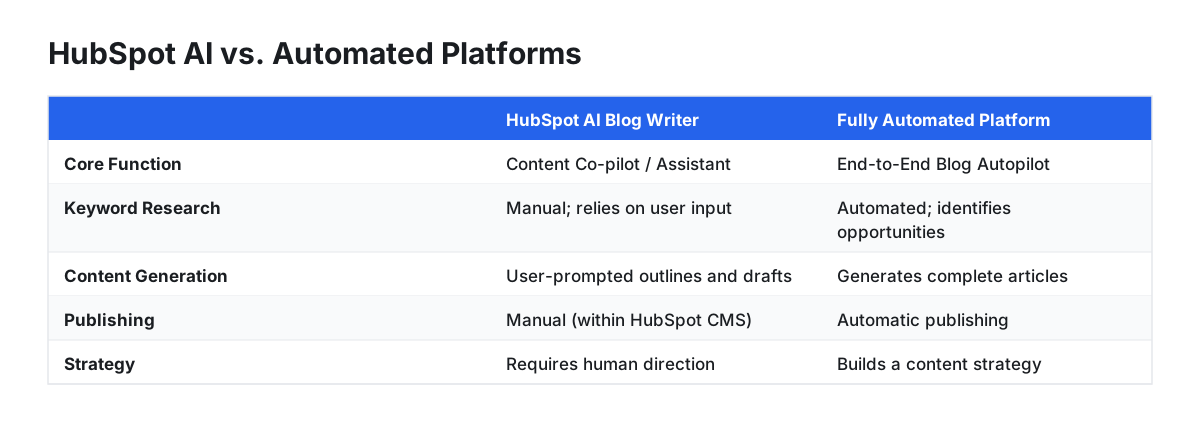 HubSpot's AI tools are powerful assistants, but they still require a human in the driver's seat for strategy, optimization, and publishing. This approach works well for teams with dedicated content marketers, but it doesn't solve the core challenge of scaling SEO content creation from end to end. This is where fully automated SEO platforms offer a different solution.
An AI assistant helps you write faster. An AI automation platform handles the entire process for you.
Here’s a breakdown of the key differences:
| Feature | HubSpot AI Blog Writer | Fully Automated Platform (e.g., PilotScribe) |
|---|---|---|
| Core Function | Content Co-pilot / Assistant | End-to-End Blog Autopilot |
| Keyword Research | Manual; relies on user input | Automated; identifies high-opportunity keywords |
| Content Generation | User-prompted outlines and drafts | Generates complete, SEO-optimized articles |
| Publishing | Manual (within HubSpot CMS) | Automatic publishing to WordPress, Shopify, Webflow & more |
| Post-Publishing | Manual performance tracking | Automated rank tracking and content improvement |
| Strategy | Requires human direction for all steps | Analyzes business and builds a content strategy |
While HubSpot helps you execute a content strategy more efficiently, platforms like PilotScribe are designed to create and execute the strategy for you. After analyzing your website, PilotScribe writes SEO-optimized long-form articles, publishes them on a schedule, and then takes it a step further. A key differentiator is that PilotScribe automatically monitors how each article ranks on Google and improves the ones that underperform, creating a self-correcting loop that an assistant tool can't replicate.
For founders and agencies who need to drive organic traffic without becoming full-time content managers, a truly automated system is the next logical step. If you need to scale SEO results without scaling your manual workload, PilotScribe puts your entire blog strategy on autopilot, from keyword discovery to a consistently published, high-performing blog.
FAQ
Which AI platform is best for blog writing?
For hands-on assistance, AI writers like Jasper and Claude are excellent co-pilots. However, for a fully automated solution that manages the entire SEO blogging workflow from keyword research to publishing and performance monitoring, PilotScribe is the best platform. It's designed to run your blog on autopilot.
Is HubSpot good for blogging?
Yes, HubSpot is an excellent platform for blogging. It combines a user-friendly CMS with powerful marketing automation and analytics tools. The addition of its AI content assistants makes it an even more comprehensive solution for businesses already invested in its ecosystem.
Are blogs still a thing in 2026?
Absolutely. Blogs remain one of the most effective channels for driving consistent, high-intent organic traffic from search engines. In 2026, a well-executed blog strategy is essential for building brand authority, educating customers, and generating qualified leads.
Is HubSpot blog free?
Yes, you can start a blog for free using HubSpot's CMS Hub Free. The free tools also include access to the AI content creation features, though usage is typically limited. More advanced capabilities and higher generation limits are included in HubSpot's paid plans.