The short answer
Whether anyone holds copyright in text that an AI wrote largely on its own is unsettled and depends on human authorship and on the country whose law applies. What a tool's terms can give you is a contractual right to use and publish that text.
The "AI owns it", "you own it" and "nobody owns it" claims are each partly right because they answer different questions. This article separates those questions and gives you a checklist and a workflow you can apply to any AI writing tool.
This is general information, not legal advice. Verify the legal points below for your jurisdiction, starting with the U.S. Copyright Office's page on copyright and artificial intelligence.
Three layers people blur together
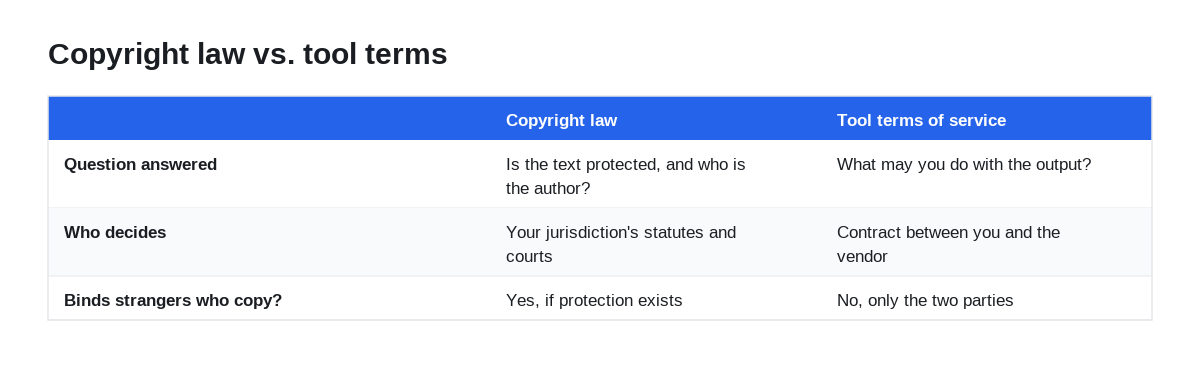
| Layer | Question it answers | Who decides |
|---|---|---|
| 1. Copyright law | Is this text protected at all, and who is the author? | Your jurisdiction's statutes and courts |
| 2. Tool terms of service | What may you do with the output, and under what conditions? | The contract between you and the vendor |
| 3. Practical protection | Can you prove your claim and enforce it? | Your records, process and publishing setup |
A contract sits only in layer 2. A vendor can say "the content is yours to use", but that is a promise between you and the vendor; whether the text is protected against others is a question for layer 1.
Layer 1: what copyright law generally requires
Copyright traditionally depends on human authorship in many jurisdictions, and how that applies to AI-generated text is still being worked out. For the US position, read the U.S. Copyright Office's guidance on copyright and artificial intelligence directly rather than relying on summaries.
Two cautions apply:
- Jurisdiction matters. Countries may handle computer-generated works differently, so don't treat any single rule as settled. Check the law where you publish and where your readers and copiers are.
- "AI-assisted" is not one thing. Accepting a raw draft unchanged is very different from substantially rewriting, restructuring and adding original material.
Layer 2: ownership versus the right to use
Tool terms can deal with use rights rather than copyright. Be precise about the wording: "you own the output", "you hold the rights to use and publish" and "we assign all rights" are three different promises. None of them overrides layer 1.
A self-audit checklist for any AI writing tool's terms
- Ownership or license? Does it say you own, hold rights to use, or receive a license? Is it exclusive?
- Scope. Is use limited to your own site, or can you resell, syndicate or deliver to clients?
- Payment conditions. Are the rights conditional on an active, paid subscription?
- Termination. What happens to content already published if you cancel or are suspended?
- Training on your data. Are your inputs or outputs used to train models?
- Indemnity. Does the vendor cover third-party infringement claims, or does it disclaim them?
- Third-party content. Who is responsible if the output resembles existing text or includes protected material?
- Governing law. Which country's law and courts govern disputes?
- Review duties. Who must check accuracy and legal compliance before publishing?
A conditional example: one tool's wording
PilotScribe's Terms of Service are one example of how an automation tool can phrase this. Its terms say that PilotScribe produces editorial content using artificial intelligence models. On ownership, they state that PilotScribe retains the intellectual property rights in the service, technology, interface and trademarks, and that, subject to payment of the subscription, the Customer holds the rights to use and publish the editorial content generated for their own website. The same terms say the customer remains solely responsible for reviewing, validating and publishing the content and for its compliance with applicable laws, including intellectual property, and that if no action is taken in the review window, automatic publication is accepted. Disputes fall under French law.
Read carefully, that wording grants a right to use and publish for your own website, conditional on payment. It does not say the text is copyrightable, and it does not address resale or client transfer. The terms are silent on what happens to previously published content after cancellation. For training on customer data and indemnity, check the full current terms or ask the vendor. Apply the same scrutiny to any tool you use.
Layer 3: strengthening your position in practice
If you want to support a claim over a post, documented human contribution is something you can control. Things that can help:
- Substantive editing: restructuring arguments, rewriting passages, correcting claims, not just fixing typos.
- Original input: your own data, interviews, screenshots, examples, opinions and product knowledge.
- Selection and arrangement: choosing which topics, sections and sources go in, and in what order.
- Records: keep prompts or briefs, the raw draft, your edited version and dates.
Whether those contributions are enough to be protected in your jurisdiction is a legal question. But without records you will have nothing to show either way.
Risks that have nothing to do with ownership
Even if you have clear use rights, you can still publish a problem:
- Overlap with existing text. Run a plagiarism or similarity check before publishing.
- Factual errors. The PilotScribe terms themselves warn that generated content may contain inaccuracies, and that is a fair caution for any AI tool.
- Trademarks and claims. Competitor names, comparisons and product claims can raise advertising or consumer-law issues.
- Industry disclosures. Regulated sectors may require specific wording or disclaimers.
A workflow for automated publishing
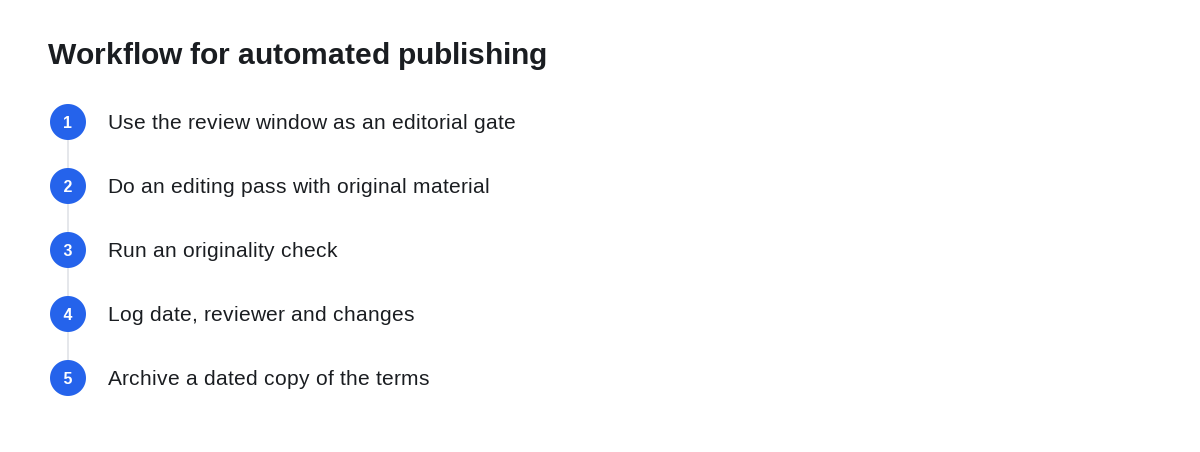
Automation makes it easy to skip the human review step, which helps with both quality and accuracy. A practical routine:
- Use the review window. If your tool offers one, treat it as a required editorial gate. PilotScribe describes a review window before each article goes live, and silence means automatic publication, so assign a person to check every draft.
- Do an editing pass. Add original material and fix accuracy.
- Run an originality check.
- Log it. Keep a simple record per post: date, reviewer, what changed, sources added.
- Archive the terms. Save a dated copy of the vendor's terms in force when you published.
When to involve a lawyer
Get advice if you plan to sell or license posts to others, if you are an agency delivering content to clients (can you pass on rights you only hold as a use right?), or if you want to register a work. Also ask when the content is high-value or in a regulated industry.
FAQ
Can others copy my AI-written blog posts? If the text has no protectable human authorship in your jurisdiction, you may have little copyright to enforce. Added human work may still help. Ask a local lawyer.
Can I register copyright in an AI-assisted post? Registration rules depend on human authorship and on current Copyright Office guidance. Check the U.S. Copyright Office's page on copyright and artificial intelligence and consider counsel before filing.
Can an agency transfer ownership to a client? An agency can only transfer what it has. If its tool grants use rights rather than ownership, a contract with the client should describe the rights granted accurately instead of promising copyright. Have the agency terms reviewed.
Does my tool's "you own the content" clause settle it? No. It settles your relationship with the vendor. Copyright law decides whether the text is protected against third parties.