
The best AI SEO blog writer is a platform that automates the entire content lifecycle, from keyword research to writing, publishing, and performance tracking. Some tools act as powerful co-pilots for expert marketers, like Surfer SEO, while others like PilotScribe offer full automation for a hands-off approach.
Choosing the right tool is a strategic decision. Do you need an assistant to speed up your existing workflow, or a fully autonomous system to run your blog for you? This guide provides a detailed, evidence-based review of the top contenders to help you choose the right platform for your goals in 2026.
Our Evaluation Framework
To provide a genuinely useful comparison, we evaluated each tool against a consistent set of criteria. We focused on real-world application rather than just marketing claims. Our analysis is based on a deep dive into each platform's functionality, user workflow, and unique value proposition.
Here’s what we looked for:
- Core SEO Functionality: How well does the tool integrate SEO? We looked beyond basic keyword insertion to features like SERP analysis, internal linking suggestions, and data-driven content structuring.
- Output Quality & Usefulness: Is the generated content well-researched, factual, and coherent? We assessed how much editing is required to get from a first draft to a publishable piece.
- Workflow & Ease of Use: How intuitive is the platform? A great tool saves time and reduces friction, whether you're a solo creator or a large team.
- Value Proposition: What makes this tool unique? We identified the standout features and target audience that give each platform its edge.
How to Choose the Right AI SEO Writer

Before you invest in a tool, use this framework to clarify your needs. The 'best' tool is the one that fits your specific process and goals.
Define Your Workflow: Co-pilot or Autopilot?
- Co-pilot tools (Human-in-the-Loop): Platforms like Jasper and Surfer SEO act as assistants. You provide the strategy, keywords, and final edits. They accelerate research and writing but require your direct involvement. This is ideal for hands-on SEOs and content teams with established processes.
- Autopilot tools (Fully Autonomous): Platforms like PilotScribe are designed to manage the entire process. You set the initial strategy (e.g., provide your website URL), and the system handles keyword research, content creation, publishing, and even performance monitoring. This is built for founders, agencies, and marketers who want the results of content marketing without the weekly operational overhead.
Assess Content Quality Needs:
- Factual Accuracy: If you write about news, trends, or technical topics, look for tools that use real-time data access (like KoalaWriter or options in Writesonic). This prevents the AI from citing outdated information.
- Stylistic Control: If maintaining a specific company persona is critical, prioritize tools with strong style and tone customization features (like Jasper).
Evaluate Core SEO Features:
- On-Page Optimization: Do you need granular, real-time feedback on keyword density and topic coverage? Tools like Surfer SEO excel here, providing a score-based editor to guide your writing.
- Content Strategy: Do you need help finding what to write about? Look for platforms that include robust keyword research and clustering based on real search volume data.
Consider the Pricing Model:
- Per-Word/Credit: Common in many tools, you pay for what you generate. Can be cost-effective for infrequent use but expensive for high-volume publishing.
- Tiered/Seat-Based: Standard SaaS plans that offer a set of features and user limits for a monthly fee. Better for predictable budgeting and team use.
Best AI SEO Blog Writers: 2026 Comparison
Here’s a quick overview of the top AI SEO writing tools. We've included specific starting prices to help you compare real costs.
| Tool | Best For | Starting Price | Standout Feature |
|---|---|---|---|
| Jasper | Versatility & marketing teams | $49/mo | Advanced brand style and tone customization |
| Surfer SEO | Data-driven content optimization | $89/mo | Real-time content score based on live SERP analysis |
| PilotScribe | Full automation & hands-off growth | Custom plans for SMBs & Agencies | Watches Google rankings & auto-improves underperforming content |
| SEOWriting.ai | Bulk content & programmatic SEO | $19/mo (Freemium avail.) | One-click, SERP-analyzed article generation at scale |
| KoalaWriter | Factual & affiliate content | $29/mo | Integrates live Google data for accurate, real-time content |
| Junia AI | High-quality, human-like output | $39/mo | Advanced rewriting engine to create unique, undetectable text |
| Writesonic | All-in-one marketing toolkit | $20/mo (Freemium avail.) | Includes AI writer, image generator, and landing page creator |
| ChatGPT Plus | DIY & budget-conscious users | $20/mo | Unmatched flexibility via custom instructions & GPTs |
Detailed Reviews of the Top 8 AI SEO Writers
1. Jasper
Jasper is a versatile AI writing assistant designed for marketing teams who need to create a wide range of content while maintaining a consistent company persona. Its standout feature is its 'Brand Voice' capability, where you can upload style guides, product docs, and existing content to train the AI on your specific tone, style, and facts.
The user experience is centered around a library of 50+ templates (from blog posts to video scripts) and a long-form document editor. You can use 'Recipes'—pre-built workflows with a series of commands—to structure and generate content efficiently. While it has SEO capabilities, they are less central than in hyper-specialized tools; it's a writer's tool first.
- Best for: Marketing teams needing a flexible co-pilot for various content types.
- Starting Price: $49/mo for the Creator plan.
- Pros:
- Excellent at learning and applying a specific writing style.
- Extensive template library speeds up creation of non-blog content.
- Strong collaboration features for teams.
- Cons:
- Core SEO features require integration or are less robust than dedicated SEO tools.
- Can be expensive for teams as user seats add up.
2. Surfer SEO
Surfer SEO is a data-driven content optimization platform built for SEO professionals who want to systematically outrank their competitors. Its core workflow revolves around the Content Editor, which gives you a real-time 'Content Score' from 0 to 100 as you write. This score is based on a deep analysis of the top-ranking pages for your keyword.
The editor provides an actionable checklist, suggesting word count, heading frequency, and a list of NLP-derived keywords and phrases to include. Its AI writer, integrated into this editor, is designed specifically to help you meet these data-backed targets. It’s less of a free-form creative writer and more of a precision instrument for competitive SERPs.
- Best for: SEOs and content teams who prioritize data-backed optimization.
- Starting Price: $89/mo for the Essential plan.
- Pros:
- Provides a clear, gamified path to on-page optimization.
- Excellent for auditing and improving existing content.
- SERP Analyzer and Keyword Research tools are top-notch.
- Cons:
- Steeper learning curve than simpler tools; can feel overwhelming for beginners.
- The focus on metrics can sometimes lead to writing that 'chases the score' at the expense of natural flow.
3. PilotScribe
PilotScribe operates on a different model entirely: it's a fully autonomous AI SEO platform designed to run your blog for you. Instead of acting as a co-pilot, it functions as an autopilot system. The process begins when you provide your website URL. PilotScribe analyzes your business, identifies high-opportunity keywords using real search-volume data, writes complete long-form articles, and publishes them on a set schedule.
Its key differentiator is the feedback loop. PilotScribe integrates with Google Search Console to monitor the performance of every article it publishes. If a post is underperforming or starts to decay, the system automatically rewrites titles or refreshes content to improve its rankings. It's a hands-off solution for generating consistent, performance-driven content.
- Best for: Founders, SMBs, and agencies who want the results of SEO without the day-to-day management.
- Pricing: Custom plans tailored for different business sizes and agency needs.
- Pros:
- True 'set it and forget it' automation of the entire content lifecycle.
- Unique performance-monitoring and auto-improvement feature closes the loop on SEO.
- No complex setup; it integrates directly with WordPress, Shopify, Webflow, and more.
- Cons:
- Not suitable for users who want granular control over every word and heading.
- Focus is exclusively on long-form blog content, not other marketing copy.
4. SEOWriting.ai
SEOWriting.ai is built for one thing: generating SEO-optimized articles at high speed and scale. Its signature feature is the one-click blog post generator. You provide a keyword, and it handles the rest—analyzing the SERPs, creating an outline, and writing a full draft in minutes. It's exceptionally efficient.
The tool is particularly strong for programmatic SEO and bulk content creation, allowing you to upload a list of keywords and generate dozens of articles simultaneously. While the initial drafts are well-structured for SEO, they often benefit from a human touch to add a more distinctive perspective before publishing.
- Best for: Affiliate marketers and content managers focused on high-volume publishing.
- Starting Price: $19/mo, with a free plan available.
- Pros:
- Incredibly fast and efficient for generating first drafts.
- Powerful bulk generation capabilities.
- Very competitive pricing model makes it accessible.
- Cons:
- Output can sometimes lack the nuance and creative flair of more advanced tools.
5. KoalaWriter
KoalaWriter has carved out a niche with affiliate marketers and bloggers who require factually accurate, up-to-the-minute content. Its main advantage is the option to use its 'GPT-4 + Real-Time Data' mode. This connects the AI to live Google search results, enabling it to write about current events, cite recent data, and create content that isn't limited by the AI model's training cutoff date.
Its workflow is simple and effective, with a focus on creating specific types of SEO content like product roundups. For example, it can write an Amazon affiliate review article and automatically pull in product details, pros, and cons, saving countless hours of manual research.
- Best for: Affiliate marketers and writers who need timely, fact-based articles.
- Starting Price: $29/mo.
- Pros:
- Live data integration ensures content is fresh and accurate.
- Specialized features for affiliate content are a huge time-saver.
- Clean, user-friendly interface with minimal learning curve.
- Cons:
- Fewer general-purpose marketing templates than all-in-one platforms.
6. Junia AI
Junia AI focuses on producing high-quality, long-form content that reads as if it were written by a human. It positions itself as a tool for creating undetectable AI content that provides genuine reader value. Its process involves a deep analysis of top-ranking articles to understand search intent and craft a comprehensive, authoritative piece.
One of its most powerful features is its rewriting engine, which can take existing text or a rough AI draft and elevate it, improving flow, originality, and depth. This makes it a great choice for users who want to create cornerstone content or thought leadership articles that go beyond basic SEO optimization.
- Best for: Content marketers and SEOs focused on premium, human-like long-form articles.
- Starting Price: $39/mo.
- Pros:
- Excellent at generating nuanced, high-quality long-form drafts.
- The 'AI Rephrase' and 'Content Expander' features are very effective.
- Cons:
- The interface is functional but not as polished as some of the top-tier competitors.
7. Writesonic
Writesonic is an all-in-one AI marketing suite. It's a Swiss Army knife that offers a blog writer, an AI image generator (Photosonic), a landing page builder (Audiosonic), and dozens of other templates for ads, emails, and social media. Its value comes from consolidating many tools into one subscription.
Its article writer, the Sonic Editor, is a capable tool that functions similarly to Jasper or ChatGPT, but with built-in SEO features and the ability to pull in real-time data from Google. If your content needs are diverse, Writesonic offers an incredible amount of functionality for its price point.
- Best for: Solo marketers and small businesses needing a single platform for all AI content creation.
- Starting Price: $20/mo, with a free plan available.
- Pros:
- Huge range of tools covers almost every marketing content need.
- Factual, up-to-date content with its Google Search integration.
- Generous free plan and affordable paid tiers.
- Cons:
- As a 'jack of all trades,' its individual tools may be less specialized than dedicated platforms.
8. ChatGPT Plus
ChatGPT, with a Plus subscription, is the ultimate DIY AI writer. For just $20/month, you get access to GPT-4, which is the underlying model for many specialized tools. With custom instructions, you can train it on your desired tone and format, and with web browsing, it can access current information.
However, it's a blank slate. It performs no automated SERP analysis, offers no content scoring, and has no native CMS integrations. You are the SEO strategist. You must perform the keyword research, analyze competitors, engineer the prompts, build the outline, and heavily edit the output. It's the most powerful raw material, but requires the most skill to shape into rank-worthy content.
- Best for: SEOs with deep expertise, users on a tight budget, and those who enjoy prompt engineering.
- Starting Price: $20/mo.
- Pros:
- Incredibly powerful and flexible for any conceivable writing task.
- Unbeatable value for the price.
- Custom GPTs allow you to build your own specialized writing assistants.
- Cons:
- Requires a huge amount of manual work and SEO knowledge.
- Lacks the purpose-built workflows and guardrails that save time in specialized tools.
The Verdict: Co-Pilot vs. Autopilot
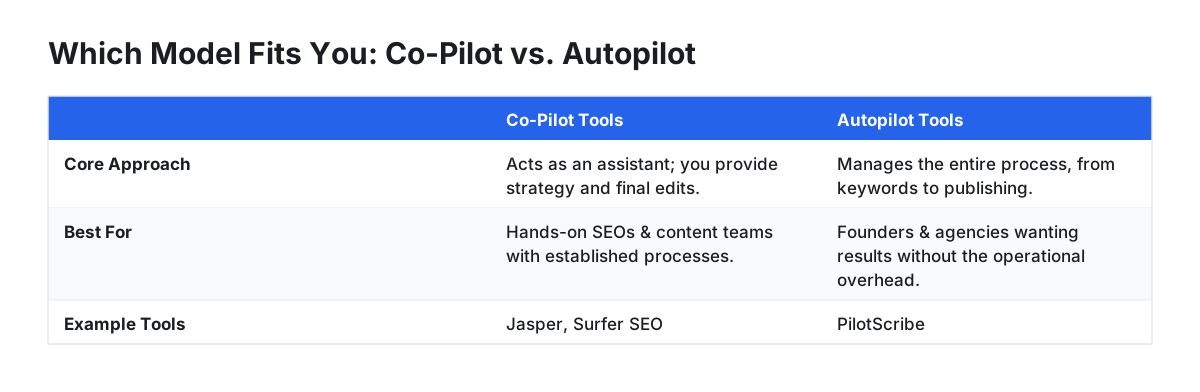
Your choice comes down to how you want to work. If you have an established content team and SEO process, a co-pilot like Surfer SEO or Jasper is a phenomenal force multiplier, making your team faster and more data-driven.
But if you're a founder, small business, or agency where time is the scarcest resource, the overhead of managing even an AI-assisted blog can be too much. For you, the autopilot model is the breakthrough. It delivers the results of a dedicated content team without the cost and complexity.
If you're ready to put your blog's growth on a truly autonomous system—from keyword discovery to publishing and performance-based improvement—explore how PilotScribe can work for you.
FAQ
Which AI is best for SEO blog writing?
The best AI depends on your needs. For full, hands-off automation from keyword research to publishing and performance monitoring, PilotScribe is the leading choice. For data-driven marketers who want to manually optimize every detail of an article, Surfer SEO is an industry-leading option.
Is there a free AI for SEO writing?
Yes, there are free options with limitations. ChatGPT's free version is great for brainstorming, while tools like SEOWriting.ai and Writesonic offer free plans that let you generate a few articles per month. These are excellent for testing but not for running a full content strategy.
Does Google penalize AI-written content?
No, Google does not penalize content simply because it was created using AI. Google's policy is to reward high-quality, helpful content that satisfies search intent, regardless of how it was produced. It penalizes spammy, low-quality content, whether written by a human or an AI.