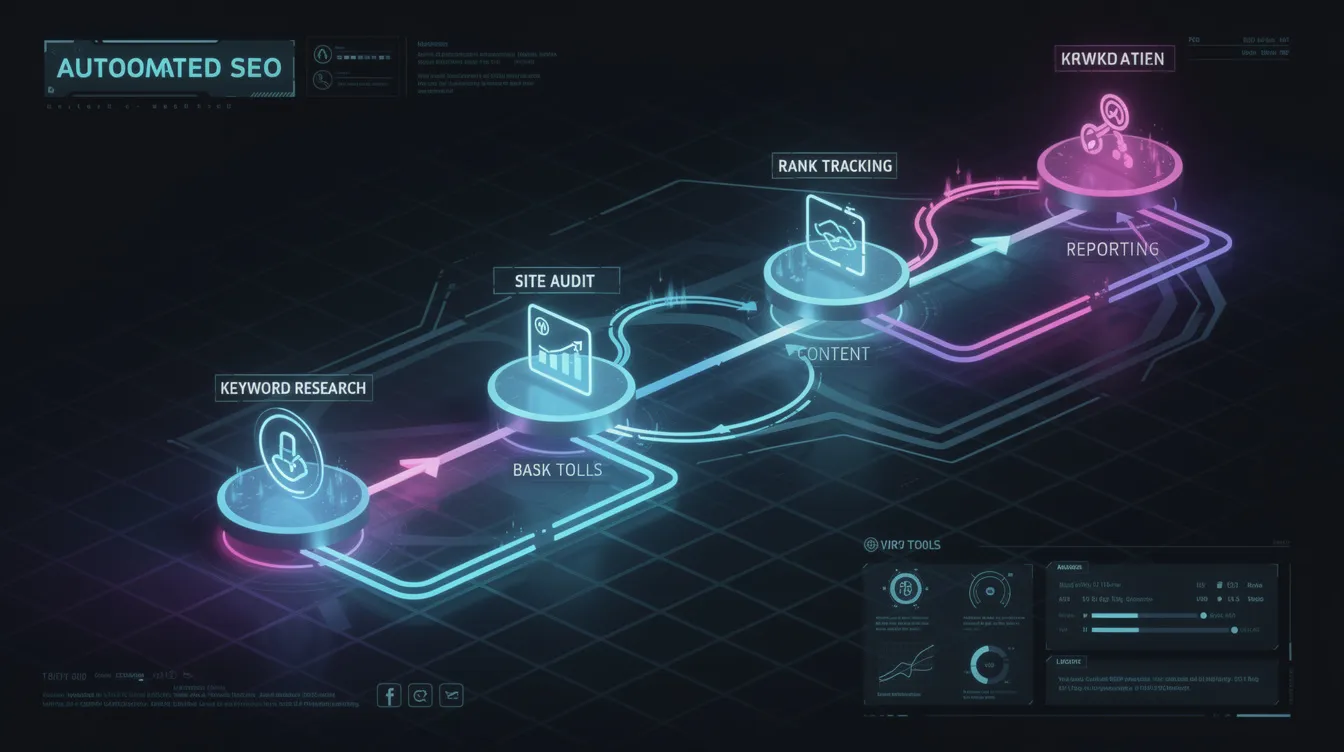
SEO automation software uses rules-based logic and AI to perform repetitive SEO tasks like rank tracking, site audits, backlink monitoring, and content creation. These platforms don't replace strategists; they augment them, allowing teams to offload manual work, reduce error, and focus on the high-impact decisions that drive organic growth.
This guide moves beyond a simple ranked list. We'll categorize the tools into four distinct tiers of automation, from simple task-handlers to fully integrated workflow platforms. This framework will help you identify not just a single tool, but the right stack for your business size, team skills, and growth objectives.
A Framework for SEO Automation: The Four Tiers
Choosing the right tool isn't about finding the "best" one, but about matching the tool's core function to your primary bottleneck. We've broken the market into four tiers:
- Task Automation (All-in-One Platforms): These are the jack-of-all-trades suites like Semrush and Ahrefs. They automate discrete, recurring tasks (e.g., daily rank checks, weekly site crawls) within a single, integrated environment. They're ideal for centralizing core SEO operations.
- Specialized Automation (Point Solutions): These tools are masters of one domain. They don't try to do everything, but they offer deep, best-in-class automation for a specific function, like real-time technical monitoring (ContentKing) or on-page content optimization (Surfer SEO).
- End-to-End Content Automation: This emerging category automates an entire workflow from start to finish. Instead of just handling a task, platforms like PilotScribe manage the whole content lifecycle: from keyword discovery and article writing to publishing and performance monitoring.
- Workflow & Enterprise Automation: This tier is for building custom automation stacks and operating at scale. It includes workflow hubs like n8n that connect multiple tool APIs, and enterprise platforms like Botify that handle millions of pages with predictive analytics.
Comparison of Top SEO Automation Tools by Tier
| Tool | Automation Tier | Best For | Key Automation Feature | Pricing Model |
|---|---|---|---|---|
| Semrush | 1. Task Automation | Centralizing core SEO tasks | Scheduled site audits & customizable PDF reports | Paid plans with limited free tier |
| Ahrefs | 1. Task Automation | Backlink & keyword movement alerts | Alerts for new/lost backlinks & keyword ranking changes | Subscription only, no free tier |
| ContentKing | 2. Specialized Automation | Real-time technical monitoring | 24/7 site monitoring with instant change alerts | Subscription pricing |
| Screaming Frog | 2. Specialized Automation | Deep, scheduled technical audits | Command-line interface for automated, recurring crawls | Free version & one-time paid license |
| PilotScribe | 3. End-to-End Content | Fully autonomous blog content | Finds keywords, writes, publishes, and refreshes posts | Paid plans for different scales |
| Botify | 4. Enterprise Automation | Large-scale technical SEO | Crawling and analyzing millions of pages with machine learning | Enterprise-level subscription |
| n8n.io | 4. Workflow Automation | Building custom SEO workflows | Visually connecting APIs of different tools into a sequence | Free self-hosted & paid cloud plans |
| Gumloop | 4. Workflow Automation | No-code SEO action chains | Pre-built "recipes" for common SEO tasks like bulk page updates | Subscription-based |
Tier 1: Task Automation (All-in-One Platforms)
These platforms are the foundation of many SEO toolkits. They automate the daily, weekly, and monthly checks that are essential for good SEO hygiene.
Semrush
Best for: Centralizing core SEO tasks in one place.
Semrush excels at scheduling and reporting. Its Site Audit can be set to run weekly, automatically checking for over 140 technical and on-page issues and emailing a summary to stakeholders. Its Position Tracking tool provides daily rank updates, but its real automation power lies in setting up custom triggers—for instance, get an alert not just if your rank drops, but if a specific competitor enters the top 3 for your most valuable keyword. The limitation? While its reporting is comprehensive, building truly custom dashboards can be less intuitive than dedicated data visualization tools.
Ahrefs
Best for: Unmatched backlink and keyword movement alerts.
Ahrefs is renowned for its backlink index, and its automation reflects this strength. You can configure highly granular email alerts for new and lost backlinks, which is critical for monitoring your profile and spotting negative SEO attacks. The key difference in its Site Audit's automation is the ability to compare crawls over time, making it easy to see what changed that caused a drop in your health score. However, its alert system is batch-processed, not real-time like ContentKing, so there can be a delay of several hours.
Tier 2: Specialized Automation (Point Solutions)
When you need to solve one problem exceptionally well, a specialized tool is often the answer. These platforms offer depth over breadth.
ContentKing
Best for: Real-time technical SEO monitoring.
Unlike scheduled crawlers, ContentKing monitors your site 24/7. Its automation provides an immediate safety net. If a developer accidentally noindexes a critical section of your site, you'll get a Slack or email alert within minutes, not a week later during your next scheduled audit. It tracks everything from canonical tag changes to broken internal links, providing a complete historical log. The trade-off is its singular focus; you will need other tools for keyword research and link building.
Screaming Frog SEO Spider
Best for: Deep, scheduled technical audits.
For technical SEOs, Screaming Frog's automation power is unlocked via its command-line interface. This allows you to integrate it into any workflow. You can write a simple shell script to run a crawl on the first of every month, export specific reports (like orphan pages or redirect chains), and save them to a shared drive. This is automation at its most fundamental and powerful level.
Here’s a sample command to run a headless crawl and export key reports:
screamingfrogseospider --crawl https://example.com --headless --save-crawl --output-folder ~/ScreamingFrog/crawls --export-tabs "Internal:All,Directives:All"
Tier 3: End-to-End Content Automation
This is the cutting edge of SEO automation, where software takes over an entire multi-step process, not just a single task.
PilotScribe
Best for: Fully autonomous blog content creation and management.
PilotScribe is designed to put a company's blog on autopilot. You connect it to your website URL, and its system analyzes your business, identifies buyer-intent keywords using real search-volume data, and then writes and publishes SEO-optimized long-form articles directly to your CMS (WordPress, Shopify, Webflow, etc.).
Its automation loop is continuous. After publishing, it uses Google Search Console data to monitor each article's performance. If a post is underperforming, the system is designed to automatically refresh it or rewrite weak titles to improve its ranking. This approach automates the entire content workflow, from initial strategy to ongoing maintenance. For agencies, its MCP (AI agent) server allows for programmatic management of multiple client sites, a significant efficiency gain.
This level of automation is ideal for founders and marketing teams who need to scale organic traffic but lack the time for manual content strategy and production. See how PilotScribe automates the entire content workflow.
Tier 4: Workflow & Enterprise Automation
This tier is for advanced users, agencies, and large enterprises that need to build custom solutions or manage SEO across millions of pages.
n8n.io
Best for: Building completely custom SEO workflows.
n8n is a workflow automation hub that connects the APIs of your favorite tools. It allows you to create powerful, bespoke SEO automations without extensive coding. For example, you could build a workflow that:
- Triggers every Monday morning.
- Fetches your top 50 keywords from Google Search Console.
- Sends each keyword to Ahrefs' API to get the current top 3 ranking URLs.
- Compares this list to last week's data stored in a Google Sheet.
- Posts a summary of any changes to a dedicated Slack channel.
This is just one example. With n8n, you can automate content refreshes, internal link suggestions, and much more by chaining together the tools you already use.
Gumloop
Best for: No-code SEO action chains.
Gumloop occupies a similar space to n8n but is tailored specifically for SEOs with pre-built recipes and a no-code interface. You can create automations like "Find all pages that mention 'Feature X' but don't link to the feature page, and add an internal link." It's excellent for programmatic SEO and bulk on-page updates without needing a developer or deep API knowledge.
Botify & BrightEdge
Best for: Enterprise-scale technical SEO and content intelligence.
Platforms like Botify and BrightEdge are built for the complexity of enterprise websites with millions of pages. Botify's automation lies in its ability to pair crawl data with log file analysis and performance data at scale, providing a unified view that's impossible to achieve manually. BrightEdge focuses on content intelligence, using AI to automate opportunity identification and competitive analysis across vast content libraries. These are powerful, high-investment platforms for teams with mature SEO programs.
The Risks of SEO Automation: Where Human Oversight is Crucial
Automation is a powerful lever, but it's not a substitute for strategy. Misused, it can cause significant harm.
- The Content Quality Trap: Automating content creation at scale with low-quality AI can quickly lead to a site full of unhelpful content that Google devalues. Human review for accuracy, originality, and brand voice is non-negotiable.
- Catastrophic Technical Errors: A misconfigured rule in a tool with site-wide access can have devastating consequences. Imagine a rule that automatically adds a
noindextag to every page with a certain word in the URL. A small mistake could de-index your entire site. - Data Without Insight: Automated reports tell you what happened, but not why. A human strategist is required to interpret the data, understand the competitive context, and make informed decisions.
How to Choose Your Automation Stack: A Practical Checklist
Instead of searching for one perfect tool, think in terms of building a stack. Use this checklist to guide your decisions:
- What is your primary goal?
[ ]Save time on reporting and monitoring (Look at Tier 1 tools).[ ]Solve a deep, specific problem like technical debt or content optimization (Look at Tier 2 tools).[ ]Outsource the entire content creation process (Look at Tier 3 tools).[ ]Build custom, integrated workflows across multiple tools (Look at Tier 4 tools).
- What is your team's technical skill level?
[ ]No-Code: We need a point-and-click interface. (Semrush, PilotScribe, Gumloop).[ ]Low-Code: We're comfortable with visual workflow builders. (n8n).[ ]Code-Comfortable: We can use command-line interfaces and APIs. (Screaming Frog, direct API access).
- What is your scale?
[ ]Solo / SMB: A single all-in-one or a couple of specialized tools will suffice.[ ]Agency: You need multi-client management, white-label reporting, and workflow efficiency.[ ]Enterprise: You manage millions of pages and need advanced analytics and log file analysis (Botify, BrightEdge).
FAQ
What is the meaning of SEO automation?
SEO automation refers to the use of software and technology to execute SEO tasks with minimal human intervention. This includes activities like tracking keyword rankings, auditing a website for technical errors, monitoring backlinks, and generating reports, freeing up marketers to focus on strategy.
Can you fully automate SEO?
While you can automate many individual SEO tasks and even entire workflows (like content creation), you cannot fully automate SEO strategy. Human expertise is still required for critical thinking, creative problem-solving, and understanding user intent. The goal of automation is to empower, not replace, the strategist.
Is there a free SEO automation tool?
Yes, there are tools with free tiers that offer limited automation, such as Ahrefs Webmaster Tools or the free version of Screaming Frog (up to 500 URLs). Workflow platforms like n8n.io also have powerful free self-hosted plans. However, comprehensive, high-volume automation almost always requires a paid subscription.
How does AI impact SEO automation?
AI is transforming SEO automation by moving beyond simple, rule-based tasks. AI can now understand language and context, enabling it to generate human-quality content, identify semantic keyword opportunities, predict ranking potential, and even suggest fixes for technical SEO issues. This allows for more sophisticated and effective automation than ever before.