
Short answer: "SEO article writing service" is not one product. It's several different delivery models — a solo freelancer, a boutique consultancy, a marketplace, a full-service content agency, and automated publishing software — and they differ at least as much in scope as in writing quality. Before comparing prices, decide which job you're buying: the draft only, or the whole chain from keyword selection to a published, internally linked page. That decision explains much of the price gap you see between quotes.
Search results for this term are dominated by vendor landing pages and affiliate listicles, so this article does something different: it gives you a scoping checklist, a way to read pricing honestly, and a 90-day test you can run before signing a retainer.
Disclosure: this blog is published by PilotScribe, which sells automated SEO publishing software. Where our own product is mentioned below it is labelled as a company claim, and the buying framework is written to work regardless of which model you choose.
Draft-only vs. brief-to-published: the difference that drives price
A "1,500-word SEO article" can mean two very different deliverables.
Draft-only. You supply the keyword and the angle. The writer returns a document. You handle the brief, the internal links, the images, the meta description, the upload and the tracking. Cheapest per article, most expensive in your own hours.
Brief-to-published. The provider does keyword research, builds the brief, writes, optimizes on-page, adds internal and external links, and uploads to your CMS. That is a much larger scope than a draft, and it is priced accordingly.
When you compare two quotes, first normalize them to the same scope. Otherwise you're comparing a wheel to a car.
The five delivery models, compared
| Model | Typically includes | You still own | Best fit |
|---|---|---|---|
| Individual freelancer / specialist | Writing, often briefs and keyword research at the senior end | Strategy sign-off, publishing (unless included) | Founder-voice content, complex or technical products |
| Boutique consultancy | Strategy, topic clusters, briefs, writing, editing | Approvals, product input | Teams that need a content plan, not just pages |
| Managed marketplace | Matching you to writers, drafts, basic optimization | Keyword strategy, briefs, publishing, QA | Volume of straightforward topics with an in-house editor |
| Full-service content agency | Strategy, production, distribution, reporting | Budget and review cycles | Funded teams with a retainer and an owner internally |
| Automated publishing software | Drafting and scheduled publishing to your CMS, keyword suggestions | Review, brand facts, product judgment | Consistent cadence with no writer or editor on staff |
These are working categories rather than a formal taxonomy, and providers blur across them. None is inherently better. The failure mode is buying the wrong one: paying agency rates for volume you could automate, or buying volume when what you needed was one strategist.
What it actually costs — and why many quotes aren't public
Be skeptical of any cost "benchmark" you can't trace to a vendor's own page. Many agencies and marketplaces price on request, so listicle averages are secondhand at best. Ask each provider for its own published or quoted rate card, and note which model it prices on: per word, per piece, or a monthly subscription.
Those models are not directly comparable, and they differ on more than scope. Ask every provider for the same three figures: cost per published article at your target word count, monthly minimum, and what's excluded (images, revisions beyond the first round, CMS upload, refreshes).
A 10-point scoping checklist before you pay anyone
Run this list on a call and write the answers down. Vague answers here become disputes later.
- Who picks the keywords — you, them, or jointly? What data source do they use for search volume and difficulty?
- Who writes the brief, and can you see a sample brief before signing? In our view brief depth is a strong quality proxy — look for briefs that specify on-page optimization data, the subheadings to cover and the next steps for the reader.
- How is subject-matter input collected? A 20-minute interview or a questionnaire beats "we'll research it."
- Internal linking: does the provider link new pieces to your existing pages and product pages, or just publish orphans?
- Revisions: how many rounds, over what window, and what counts as a revision vs. a rewrite?
- Publishing: who uploads, formats, sets the slug, meta description and images?
- Refreshes: is updating an underperforming article included, or billed again?
- AI disclosure: is AI used, where in the process, and who reviews before publication?
- Sample rights: can you see unedited samples in your niche, and are they allowed to show your work in their portfolio?
- Exit: do you keep the briefs, keyword list and content calendar if you leave?
Who does the keyword research matters as much as who writes
A beautifully written article on a query nobody searches — or one you can't realistically rank for — is a sunk cost. Ask providers to walk you through how they chose three specific keywords for a past client: what data, what competition check, what intent match, and how those pieces connect into a cluster rather than sitting as isolated posts.
You can do a competent version of this yourself with free tools. Google Ads Keyword Planner is a free resource for building keyword lists, generating keyword ideas and seeing how search interest for terms has changed over time, though reaching it requires completing Google Ads account setup, creating a campaign, and switching from Smart Mode to Expert Mode (Google Ads). Google's own developer documentation notes that historical keyword metrics refresh monthly, which is a useful reminder that volume figures are estimates on a lag, not live counts (Google Ads API).
Then make sure measurement is wired in. If the provider can't see Google Search Console data for your site, neither of you can judge the work. Ask how a provider gets access to that data and what it reports back.
Can ChatGPT just write it?
It can write drafts. Whether those drafts should be published unreviewed is the real question, and Google has published guidance on it.
Google says generative AI can be particularly useful when researching a topic and adding structure to original content, but that using generative AI tools to generate many pages without adding value for users may violate its spam policy on scaled content abuse (Google Search Central). The spam policy defines scaled content abuse as generating many pages primarily to manipulate search rankings rather than help users — typically large amounts of unoriginal content with little to no value, "no matter how it's created" (Google spam policies). Google says it strengthened that policy in March 2024 to focus on the behavior of producing content at scale to boost search ranking, "whether automation, humans or a combination are involved" (Google blog).
The practical rules that follow: keep originality and value as the bar, not word count; add facts, data or a point of view the model can't get from page one; and consider telling readers how the content was created — Google suggests that if you're automatically generating content, adding information on how it was created can give readers more context (Google Search Central).
We'd add a human review step before anything goes live. That is our recommendation, not a Google requirement — and reviewing a draft does not by itself add the originality and value Google's policy asks for. Someone still has to put something in the page that wasn't there before.
A 90-day paid trial protocol
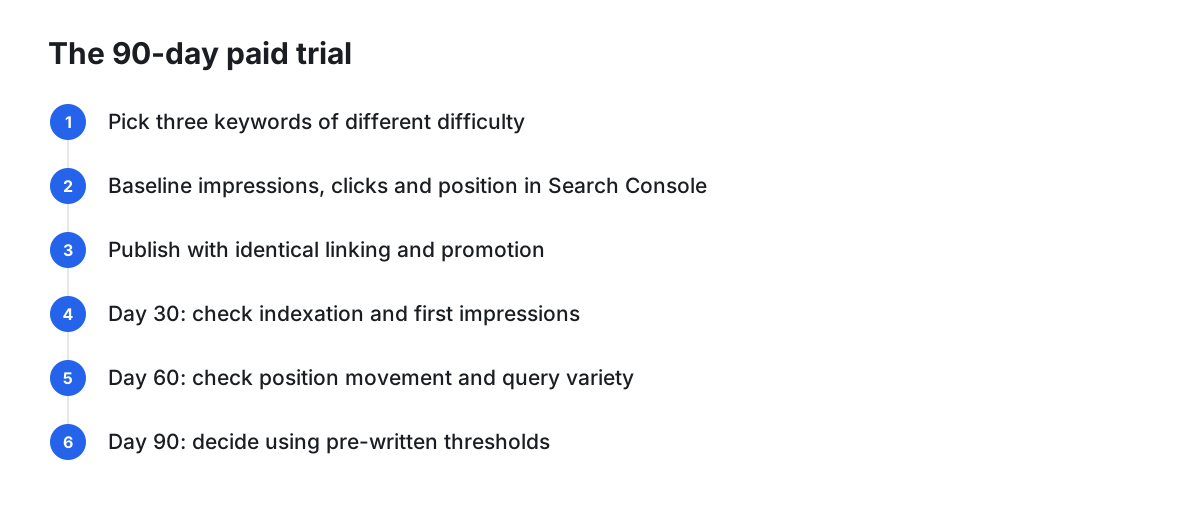
Don't sign a 12-month retainer on a sales call. Buy three articles and run a test. This is a method, not a promise of results — we found no independent outcome data for the providers cited here (the testimonials on vendor pages are published by the vendor), and anyone quoting you guaranteed rankings is selling something they can't control.
- Pick three keywords of different difficulty: one clearly long-tail, one mid, one aspirational. Agree on them in writing.
- Baseline everything in Search Console before publication: current impressions, clicks and average position for the site and for those queries.
- Publish with identical treatment — same internal linking effort, same promotion (or none), so the variable is the content.
- Check at day 30 for indexation and first impressions. No impressions at all by day 30 often points to a technical or indexation problem rather than a writing problem.
- Check at day 60 for average position movement and query variety — how many distinct queries the page surfaces for.
- Decide at day 90 using thresholds you set in advance. A reasonable pass/fail frame: the long-tail piece should be gaining impressions and ranking in a tracked position range; the mid piece should at least be surfacing for a growing set of related queries; the aspirational piece may show nothing, and that's expected.
Write your thresholds down before you see the data. Here is a hypothetical example of a pass rule, offered as illustration only: "renew if at least two of three articles are indexed within 14 days and the long-tail piece has a rising 28-day impression trend by day 90." Your numbers will differ by site authority and niche — the discipline of pre-committing is the point.
When ordinary software is enough, and when to hire a human
Start with the cheapest option that closes your actual gap. Ordinary tooling is often sufficient: free keyword research in Keyword Planner (Google Ads), Search Console for measurement, a CMS that already handles scheduling and internal links, and whoever on the team knows the product best writing the draft. If your bottleneck is that nobody has sat down to pick topics, no purchase fixes that.
Hire a human specialist when the topic is YMYL (health, finance, legal), when the piece needs original research or proprietary data, when it carries the founder's voice and point of view, or when the product is complex enough that a wrong explanation costs credibility. Also hire a human when you need strategy — a topic cluster and a positioning decision — rather than pages.
Consider automated publishing software only as a conditional option: when the bottleneck is cadence rather than judgment, on high-volume informational topics and low-competition long tail, with a small team and no editor. As the publisher of this blog, we make one: PilotScribe states that it analyzes a business's website, identifies keywords relevant to search engine optimization, writes SEO-optimized blog articles, and automatically publishes them to a hosted blog, with a review window before each goes live (PilotScribe; company claims). Treat that as a vendor description and test it the same way you'd test a freelancer.
Agency and multi-client considerations
If you're buying on behalf of clients, it is worth asking any provider where content is published (your domain or each client's own), whether there is an approval step before anything goes live, and whether reporting can be broken out per site. Whatever you choose, confirm that client data and content stay separated per site, and ask how an account is handed back if the relationship ends.
Red flags on SEO writing sales pages
- Guaranteed rankings or guaranteed traffic. Nobody controls Google's ranking systems.
- No published or quotable revision policy. One round, two rounds — fine. Unspecified is a future argument.
- No sample rights. If you can't see unedited work in a comparable niche, you're buying a brand, not a deliverable.
- Evasiveness about AI. Using AI isn't the problem; producing many unreviewed, unoriginal pages at scale is what Google's scaled-content-abuse policy targets (Google spam policies).
- Word count as the headline metric. Length is not quality, and Google described its March 2024 core update as refining ranking systems to reduce unhelpful, unoriginal content (Google blog).
Your next step
Pick the delivery model that matches your actual gap — strategy, judgment, or cadence — and check first whether free tools and an internal hour a week already close it. Scope the purchase with the 10 questions. Buy three articles, not twelve months. Then let Search Console, not a sales deck, decide whether you renew.
FAQ
How much does it cost to write content for SEO? There's no reliable public benchmark, because many providers quote privately. Pricing models also vary — per word, per piece, or a monthly subscription — so ask each provider which one it uses. Compare on cost per published article at the same scope, not per word.
Can ChatGPT write SEO content? It can produce drafts, and Google says generative AI can be useful for researching a topic and adding structure to original content. But generating many pages without adding value for users may violate its scaled content abuse policy, and Google says that policy applies whether automation, humans or a combination are involved (Google guidance, Google blog). Treat AI as a drafting layer, and make sure a person adds something original before it publishes.
How much does it cost to hire someone to do SEO? Our sources don't document market-wide rates for SEO services, so treat any single figure you see as an estimate rather than a benchmark. Collect three quotes scoped identically and compare inclusions line by line.
What is the 80/20 rule in SEO? It's a prioritization heuristic, not a Google rule: a small share of your pages and keywords usually drives most of your organic results, so you concentrate effort there. Applied to buying a writing service, it means identifying the handful of topics closest to your product and revenue before funding broad volume — and using Search Console to find which existing pages already earn impressions and deserve a refresh first.
Are there free SEO article writing services? Free drafting tools typically don't bundle the surrounding steps — keyword selection, internal linking, publishing and measurement — but you can assemble those yourself at no cash cost: Keyword Planner is free for keyword ideas and search-interest trends (Google Ads), Search Console reports impressions, clicks and positions, and most CMSs handle scheduling and links. The honest trade is your own time on briefs, facts and editing.